
Contra Costa Court Records After Arrest
A local arrest in Contra Costa County usually moves through three records systems. First, the sheriff booking record or arrest report documents the arrest basis, booking number, case type, charges listed by the arresting agency, bail columns, and release information if available. Then the Contra Costa County District Attorney's Office reviews law-enforcement reports and decides whether to file a complaint or another formal charging document. Once filed, the court case becomes the primary source for the charge that is actually pending.
That difference matters. A booking charge is an allegation used at jail intake. A filed court charge is the prosecutor's formal claim in a criminal case. The jail report can show ON VIEW, WARRANT, RAMEY WARRANT, REMAND, or COMMITMENT as a case type, while the court record tracks hearings, filings, charge status, orders, dispositions, and copy requests. For custody and booking details, use Contra Costa jail inmate records; for booking-photo issues, use the Contra Costa jail mugshots page.
Search Contra Costa Court Records
The Contra Costa Superior Court homepage links "Search Court Records & Hearings" to the official Court Public Portal at odyportal.cc-courts.org. The court describes that tool as a way to search case records and hearings. It also publishes court calendars for daily and upcoming civil and criminal cases, including hearing schedules, Zoom access, and announcements. Arrest-report information may appear before the court file is easy to locate, so spelling, date of birth, booking number, and case number all help.
- Start with the court portal or the Superior Court homepage's Search Court Records & Hearings link.
- Search by defendant name or case number when known.
- Open the criminal case and compare the filed charge with the jail booking charge.
- Check court dates, charge status, and disposition fields instead of relying on a jail report for final case outcome.
- Request documents from the clerk when minutes, case documents, or orders are not available online.
The Contra Costa Superior Court homepage is the official public starting point for court records after a jail arrest and for the court portal link.
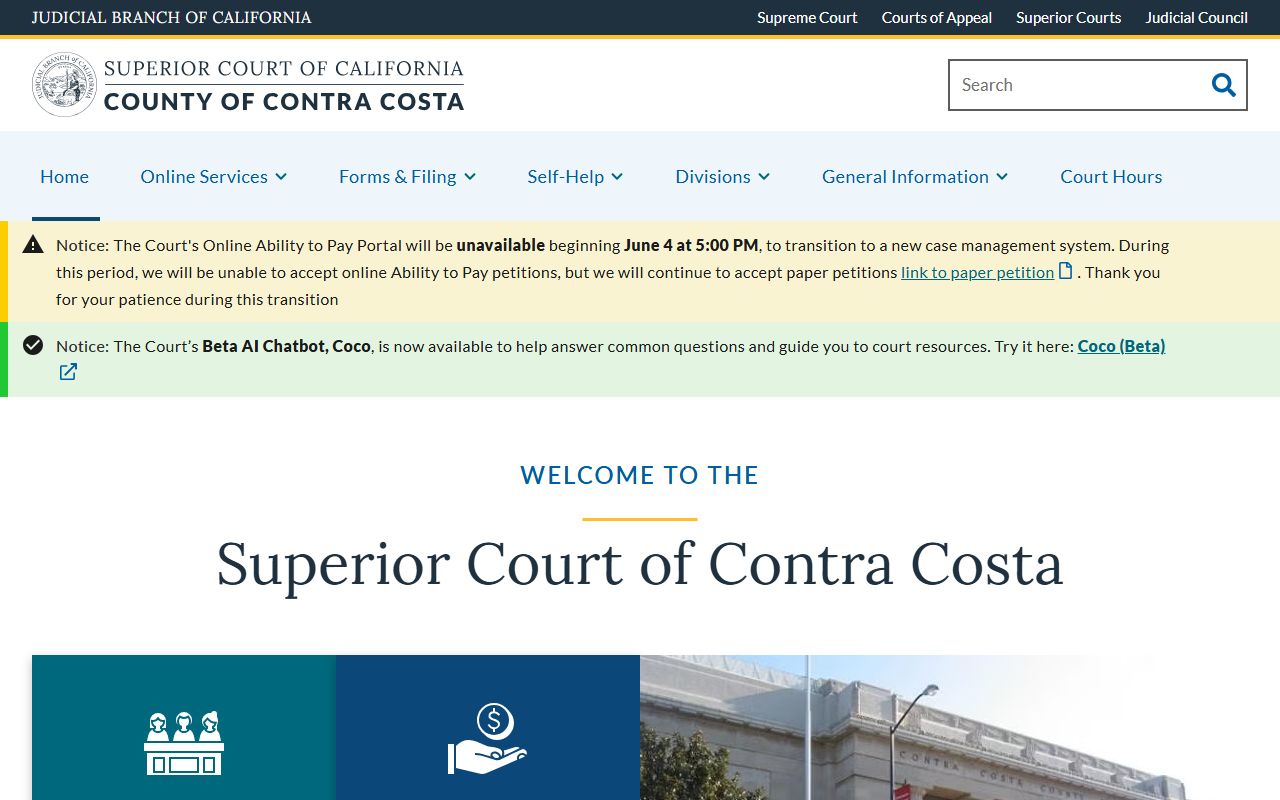
The homepage route matters because the court notes that case records, hearings, calendars, and copy channels are separate from the sheriff's jail roster.
Contra Costa Criminal Copies
When a portal result does not provide the needed document, Contra Costa Superior Court uses criminal record request forms and clerk locations. Criminal Records Copies Request form CR-114 is used to request copies by mail and pay by credit card, or to attach to a request letter. Criminal Records Search Request form CR-147 is used when the clerk must search for a criminal record. The research notes that telephone and facsimile requests are not accepted for CR-147.
| Request | Use | Key Details |
|---|---|---|
| CR-114 Criminal Records Copies Request | Copy request | Copies are $0.50 per page; certification is $40 per document; card service fee is 2.99% with a $1 minimum per docket number. |
| CR-147 Criminal Records Search Request | Criminal record search | Court location boxes include Martinez, Pittsburg, and Richmond; misdemeanors are available for 10 years. |
| Criminal clerk records | In-person file and copy help | Martinez, Pittsburg, and Richmond criminal locations are listed as Monday-Friday, 8:00 a.m.-4:00 p.m.; phone help is 8:00 a.m.-3:00 p.m. |
| PI-01 Judicial Administrative Records | Administrative records only | The form says not to use it for case records. |
Contra Costa Charging Documents
The District Attorney's Office decides whether to file charges after the jail arrest. The office is led by District Attorney Diana Becton and routes formal-charge questions through (925) 957-2200. The DA's filed charge is more authoritative for court status than the arrest charge on a jail report. The jail report tells what someone was booked on; the court record tells what the prosecutor filed and how the case is moving.
| Document | Who Uses It | What It Means |
|---|---|---|
| Complaint | Prosecutor | Formal charging document used to start many criminal cases. |
| Information | Prosecutor after felony preliminary stage | Charging document often used after preliminary hearing or waiver in felony proceedings. |
| Indictment | Grand jury route | Grand-jury charging document, usually for more serious or complex felony matters. |
The Contra Costa District Attorney homepage lists prosecutor services and links court-case resources relevant after a jail arrest.
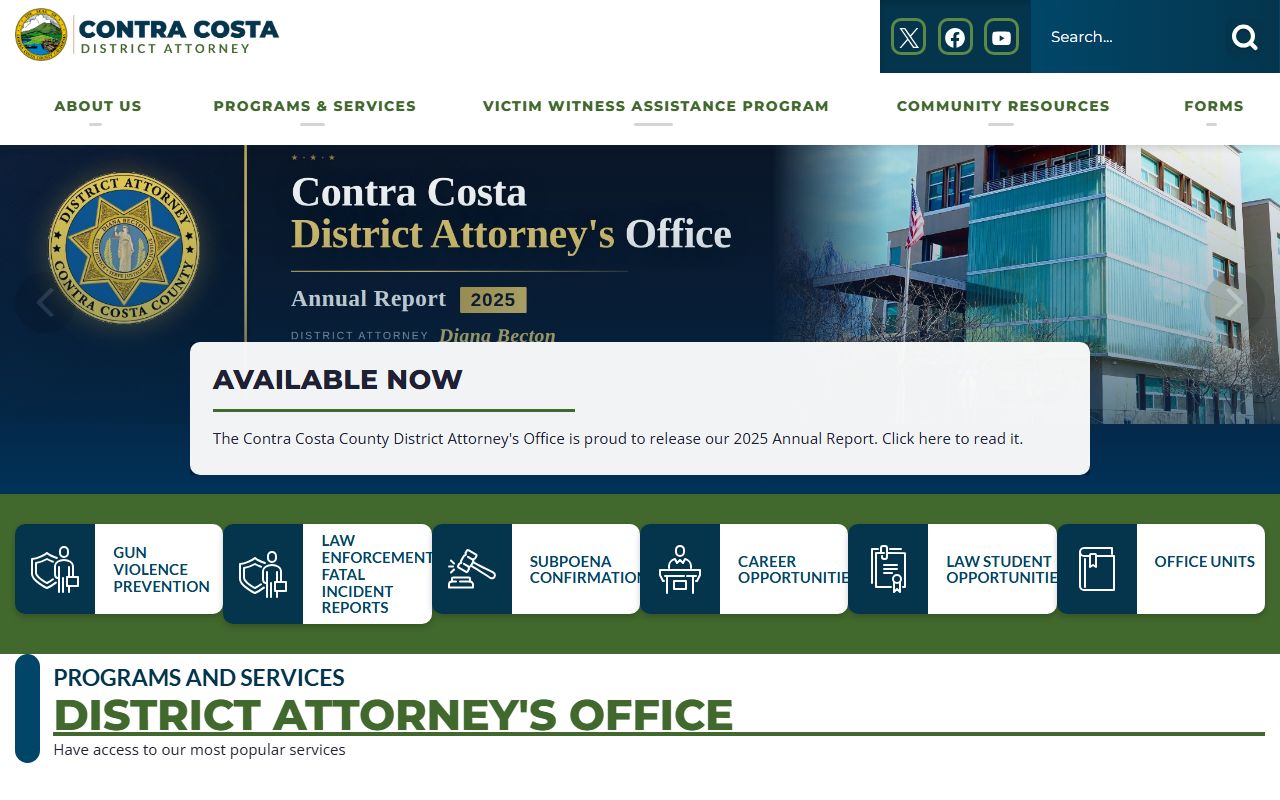
The DA page is useful for prosecutor-role context, but it is not a jail custody, release, visitation, or commissary help desk.
Contra Costa Charge Status
Charges can change after an arrest. A booking charge may be reduced, amended, replaced, or declined once the prosecutor reviews the facts. The court may later dismiss a charge, accept a plea, set trial dates, or enter a disposition. In plain terms, status means where the charge stands in the court case, not whether the person was booked into jail.
| Status | Meaning in Court Records |
|---|---|
| Pending | The filed charge remains unresolved. |
| Amended | The prosecutor or court changed the charge wording, code, or level. |
| Reduced | The charge was lowered, often from a more serious level to a lesser charge. |
| Dismissed | The charge was dropped by the court or prosecution. |
| Conviction | A guilty plea, no-contest plea, or finding of guilt resolved the charge. |
Note: State summary criminal-history information under Penal Code section 11105 is controlled and is not the same as a public jail log or court portal search.
Bail After Contra Costa Arrest
Bail after a Contra Costa County jail arrest can come from a warrant, a countywide bail schedule, or a judge's order after appearance. Penal Code section 1269b authorizes the officer in charge of a jail, certain sheriff or police employees, and court clerks to approve and accept bail fixed by warrant, schedule, or court order. The Superior Court publishes a 2025 felony bail schedule tied to that statute. After first appearance, the judge may set bail higher or lower for the person and case.
| Release Term | Meaning |
|---|---|
| Cash bail | Full bail amount is posted directly. |
| Surety bond | A certified surety insurer acts through a bail agent. |
| Own recognizance | Release based on a promise to appear, without posting full bail. |
| Cite release | Report release reason showing release by citation when allowed. |
| No-bail hold | Ordinary bail will not release the person because of a remand, warrant, hold, or detainer. |
Contra Costa Arrest Warrants
No separate official Contra Costa sheriff active-warrant public search was confirmed in the inspected sheriff pages. For public warrant checks, the research points to the Superior Court at 725 Court Street, Martinez, or (925) 608-1000. Sheriff Records & ID remains the records management center for warrants and countywide restraining orders for unincorporated areas and sheriff contract cities, but court records are the public route for warrant checks, dispositions, court dates, and restraining order information.
- Arrest warrant
- A court order to arrest based on probable cause or case status.
- Bench warrant
- A warrant often issued for failure to appear or failure to obey a court order.
- Ramey warrant
- A California pre-complaint arrest warrant based on probable cause presented to a judge.
- Detainer
- A request or hold from another agency that can affect release from county jail.
Charges and Convictions Compared
Arrest, charge, and conviction are different stages. A person may be arrested and never charged. A person may be charged and later have the charge dismissed. A conviction exists only after a guilty plea, no-contest plea, or finding of guilt. Contra Costa County court records after an arrest should be read with those stages in mind.
| Record Type | Stage | What It Proves |
|---|---|---|
| Booking charge | Jail intake | What the person was booked on, not final guilt. |
| Filed charge | Criminal case | What the DA formally filed with the court. |
| Conviction | Disposition | A plea or finding of guilt on a charge. |
Sealed Contra Costa Arrest Records
California Penal Code section 851.91 allows a person arrested but not convicted to petition to seal arrest and related records when the statute's conditions are met. Sealing is different from a routine court copy request. It limits public access to eligible arrest-related records after a qualifying no-conviction outcome, while some law-enforcement or court access may remain under the statute.
| Sealed | Expunged or Dismissed Relief | |
|---|---|---|
| Public visibility | Public access is limited for eligible arrest-related records. | Relief depends on the record type and statute used. |
| Eligibility | Arrest without conviction under Penal Code section 851.91 conditions. | Depends on conviction, sentence, and California post-conviction rules. |
| Best source | Court record and petition history. | Court order and case disposition. |
Important: Court and jail lookups are not FCRA consumer reports and should not be used for employment, housing, credit, or insurance decisions.